What the breed is like
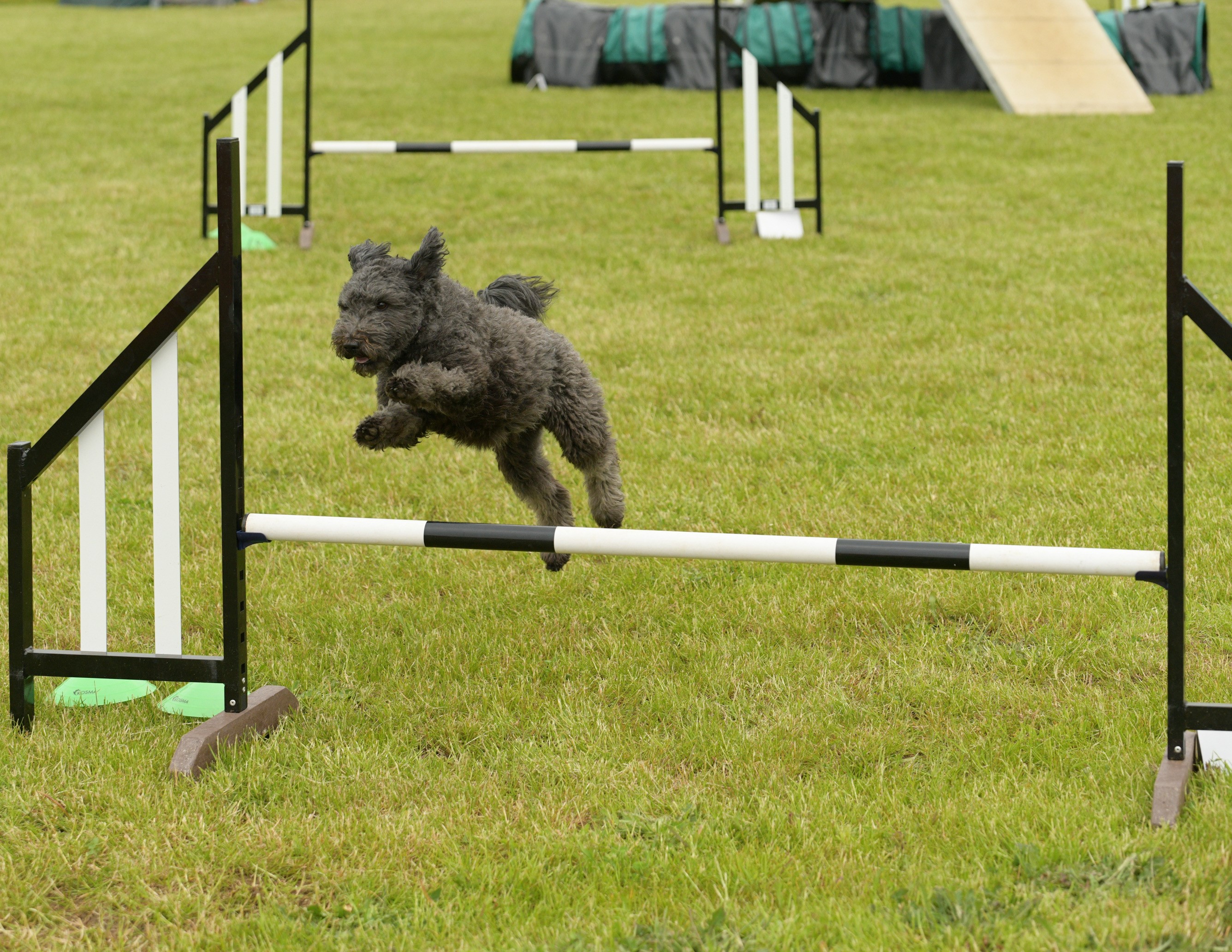
The Pumi participates in conformation shows, and becoming popular for agility, competes in herding, obedience and other dog sport and companion events. They excel in all dog sports as they want to work and are eager to please.
With daily exercise, the Pumi makes a wonderful house dog. It will bond closely with its entire family, but might prefer one family member. A Pumi will get along with children if brought into the family as a puppy.
The Pumi coat consists of 50% soft hair and 50% harsher hair, all of it the same length. A Pumi needs combing – never brushing! – every 2 to 3 weeks and then wetting down to let the coat curl back up. Once curled, the coat can be trimmed to keep it looking tidy. The Pumi doesn’t shed, but dead hair will come out when being combed. The Pumi’s hair is never blown out and fluffed with a hair dryer as that removes the characteristic curls in the coat and render it soft and cottony.
A Pumi is an active, thinking dog and must assess each new situation, so it’s best to expose it to many different situations while they’re young.
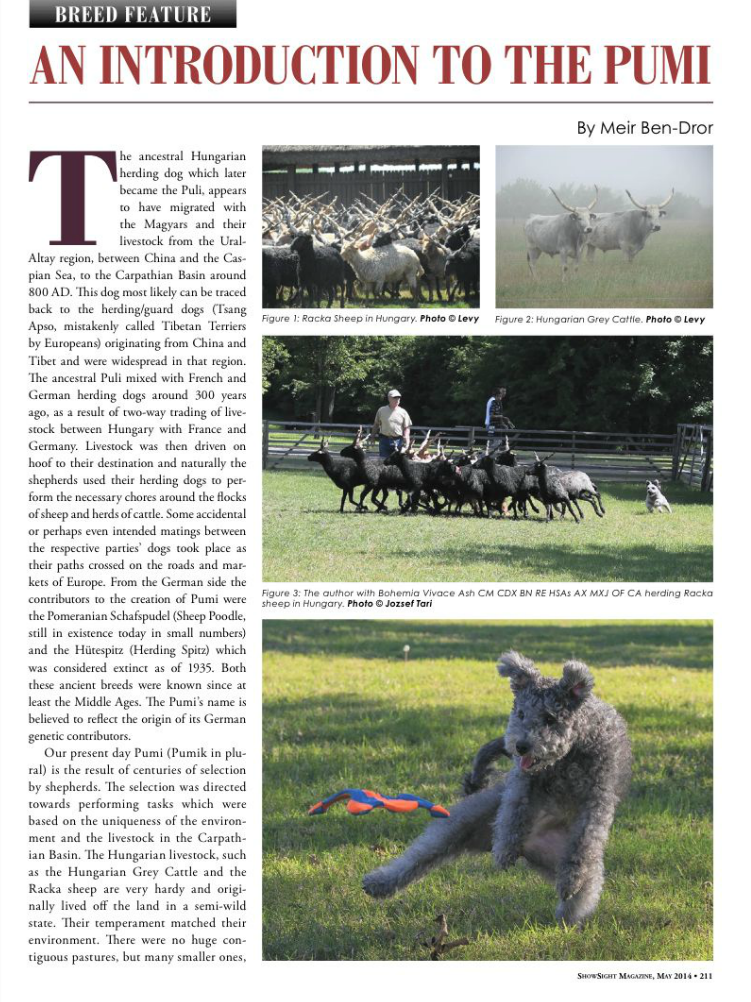
An introduction to the Pumi
Please note that the article was written in the USA. Pumis were awarded breed classes by the UK Kennel Club from April 2020.


Health
The Hungarian Pumi is a healthy breed but as a precaution breeders should test their breeding stock before planning a litter. For the breed to remain healthy it is important that dogs have undergone the following tests. Ask to see documentation when inquiring about a litter.
EYE TESTS
All puppies from all litters to be eye tested, between 6 – 8 weeks of age by an ophthalmologist on the KC/BVA panel. Puppies showing no signs of any eye disease will be accepted as interim clear. Because of the uncertainty of the results obtained for some conditions, in young puppies, all stock should be re-tested before being bred from and those affected must not be bred from.
HIP DYSPLASIA
Hip Dysplasia is an abnormal formation of the hip socket that, in its more severe from, can eventually cause crippling pain and painful arthritis of the joints. It is a genetic (polygenic) trait that is affected by environmental factors.
DM or DEGENERATIVE MYELOPATHY
Degenerative Myelopathy is a devastating disease causing progressive paralysis in a large number of dogs breeds. New research has identified a gene that is associated with a major increase in the risk of the disease. The test is done by a simple cheek swab & sent to the appropriate laboratory for testing. Dogs can be declared Clear, Carrier or genetically affected
PRIMARY LENS LUXATION (PLL)
Primary Lens Luxation (PLL) is another inherited condition that affect many breeds of dog. It is characterized by movement of the lens away from its normal location of the eye. This may result in blindness in affected adult dogs. A mutation has been identified by researchers at the Animal Health Trust which causes PLL. It is inherited as a recessive trait. A simple cheek swab can be performed & analysed by the appropriate lab. Dogs can be Clear, Carrier or Affected.
No dog with bad hips, DM affected or PLL should ever be bred from.
PATELLA LUXATION IN DOGS
Patella luxation occurs when the dog’s kneecap (patella) is dislocated form its normal anatomic position in the groove of the thigh bone (femur). When the kneecap is dislocated from the groove of the thigh bone, it can only be returned to its normal position once the quadriceps muscles in the hind legs of the animal relax and lengthen. It is for this reason that most dogs with this condition will hold their hind legs up for a few minutes. It is important for the patella (kneecap) to be stable so that the dog’s movement is not affected.
A Beginners Guide to Agility
Agility is a really fun activity to do with your Pumi. You run around a course, the dog does the obstacles and it’s your job to guide it.
You can do it just for fun and to build the bond between you and your dog and you can do it competitively.
Pumi are perfect for this fun sport, not only are they fast, intelligent and driven, it gives them a job too. Teaching a Pumi can be challenging, as they are incredibly quick to learn. This is good and bad. I’m frequently blown away with how quickly my Pumi picks up new techniques, can turn on a pin.
Dogs can train from one year but you can start basics, flatwork, obedience and foundation training before then. Beginners classes are next. Here you learn how to safely work with the equipment and once you and your dog are confident, you move up the classes to do more advanced work and course. To find a club to train at the best place to start is on agility.net on Facebook. There are quite a few helpful people who will point you in the right direction of a club which is nearby. You can either choose to train as part of a group or have 121 or 221 lessons. Group training is usually cheaper and a good way to start.

Competetive Agility
This reflects the height your Pumi jumps and is based on how tall they are at the shoulders.
If you want to do Kennel Club shows your Pumi will need to be measured before he/she can enter a show. The same goes with independent shows, however at some they do measure on the day. Dogs can be measured from 15 months. They will need to be measured twice with at least a year in between measuring. Shows are usually entered online at least 3 weeks before the show date via agility.net.
Agility net has a show diary of all shows and when you click on the show it will show you who is the processor. There are 7 grades for agility with grade 1 being the easiest and first grade you enter. You need to run a clear round (no faults) and get a first place to put this towards grade progression. To go from grade 1 to grade 2 you need two wins, one being an agility. You can see progression and get more information from the kennel club website. https://www.thekennelclub.org.uk/events-and-activities/agility/new-to-agility/ Kennel club open shows are available for all to enter (after measuring).
There are a number of different rings with jumping and agility courses set up by the judges. There are also Premier shows which hold qualifiers got events like Crufts, Discover Dogs and Olympia. You would have to qualify to enter Kennel club Championship agility shows. Here the classes are divided into three rounds. The winner and second placed dogs are awards Agility Certificate and Reserve Agility Certificate.
Nell Carter